


Which Bryant Gas Furnace Fits Your Home?
When you replace a furnace, the efficiency rating tells only part of the story. How the equipment delivers heat can also affect what you notice at home, especially if rooms feel warm during a heating cycle and cooler soon after it ends.
Schaafsma’s Bryant furnace options include the modulating Evolution 987M, two-stage Evolution 987T, and single-stage Legacy 916S. Here is how they compare and what to consider before choosing one.
Compare Bryant Furnace Models
| Furnace Model | Heating Operation | Maximum AFUE | Reason to Consider It |
|---|---|---|---|
| 987M Evolution™ 98 | Modulating | Up to 98.5% | Fine adjustments in heating output |
| 987T Evolution™ 97 | Two-stage | Up to 97% | Lower and higher heating stages for changing demand |
| 916S Legacy™ 96 | Single-stage | Up to 97% | High fuel efficiency with straightforward heating operation |
AFUE measures furnace fuel efficiency. Ratings shown are maximum published ratings and vary by size and configuration.
Evolution™ 98 Variable-Speed Modulating Gas Furnace — 987M
For homeowners who want closer temperature control
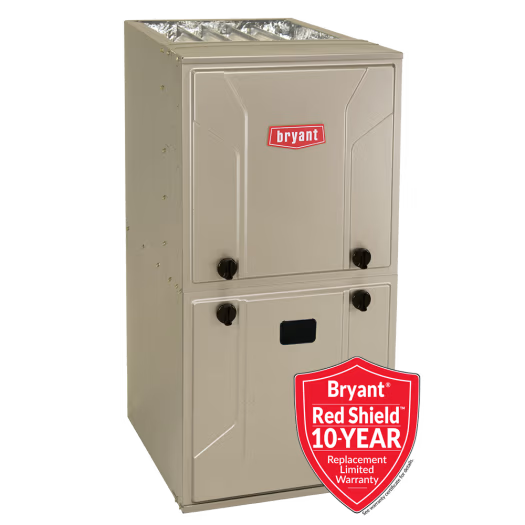
The 987M can make small changes to heat output instead of relying on one or two heating levels. That gives it more flexibility to respond as heating demand rises or falls. Its variable-speed blower adjusts airflow to support consistent comfort.
At up to 98.5% AFUE, the 987M has the highest maximum fuel-efficiency rating of these three models. If your current system leaves you frequently adjusting the thermostat, ask how modulating operation could help—and whether sizing, ductwork, or insulation also needs attention.
Evolution™ 97 Variable-Speed Gas Furnace — 987T
A lower heating stage for days that need less heat
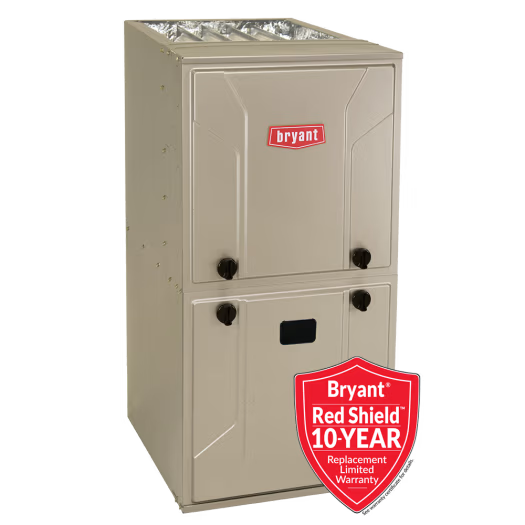
Not every winter day requires full heating output. The 987T uses a lower stage when demand is lighter and a higher stage when more heat is needed. Running at lower output for longer periods can help reduce the warm-to-cool changes associated with shorter heating cycles.
This model combines two-stage heating with variable-speed airflow and efficiency ratings up to 97% AFUE. It is a useful comparison point if you want more control over heat delivery than a single-stage furnace provides.
Legacy™ 96 Gas Furnace — 916S
An efficient option with one heating stage
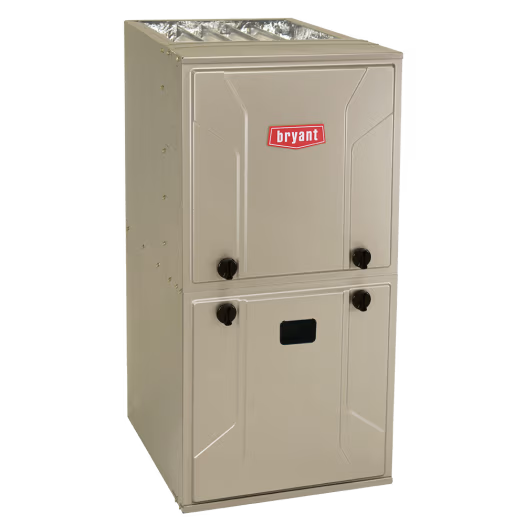
The 916S provides heat at one output level when the thermostat calls for it. It does not vary burner output like the 987M or switch between two heating stages like the 987T. Its efficiency rating still reaches up to 97% AFUE, showing that high fuel efficiency is available with simpler heating operation.
Consider the 916S if single-stage heat meets your comfort expectations. When comparing proposals, look at the complete installed price and equipment configuration rather than assuming the series name alone tells you which furnace offers the best value.
Which of these Bryant furnaces is the most efficient?
The Evolution 987M has the highest maximum rating of these three models, at up to 98.5% AFUE. The Evolution 987T and Legacy 916S each reach up to 97% AFUE. The rating for the specific size and configuration in your proposal may differ.
What is the difference between modulating and two-stage heating?
A modulating furnace adjusts heat output across a range in small increments. A two-stage furnace has a lower and a higher heating output. The 987M is modulating; the 987T is two-stage.
Does variable-speed mean the same thing as two-stage?
No. Variable-speed describes the blower that moves air through the ductwork. Two-stage describes the furnace’s heating output. The Bryant 987T combines two-stage heating with a variable-speed blower.
Why compare the 987T and 916S if both reach 97% AFUE?
AFUE measures fuel efficiency, not how a furnace adjusts its heat output. The 987T offers two heating stages, while the 916S has one. Their maximum efficiency ratings are similar, but the way they deliver heat differs.
Will a new furnace fix a cold room?
A new furnace may help if the existing equipment is part of the problem, but a cold room can also result from restricted airflow, duct leakage, or heat loss through windows and walls. Identifying the cause helps determine whether furnace replacement alone will address it.
Can the furnace blower help with air conditioning?
Yes. In a matched central heating and cooling system, the furnace blower also circulates air during cooling. Variable-speed airflow can support summer humidity control when the cooling equipment, controls, and settings are compatible.
How much could I save by replacing my furnace?
Savings depend on your current furnace’s efficiency and condition, the replacement equipment, fuel costs, weather, and thermostat settings. AFUE ratings help compare fuel efficiency, but they do not establish a guaranteed reduction in your utility bill.
